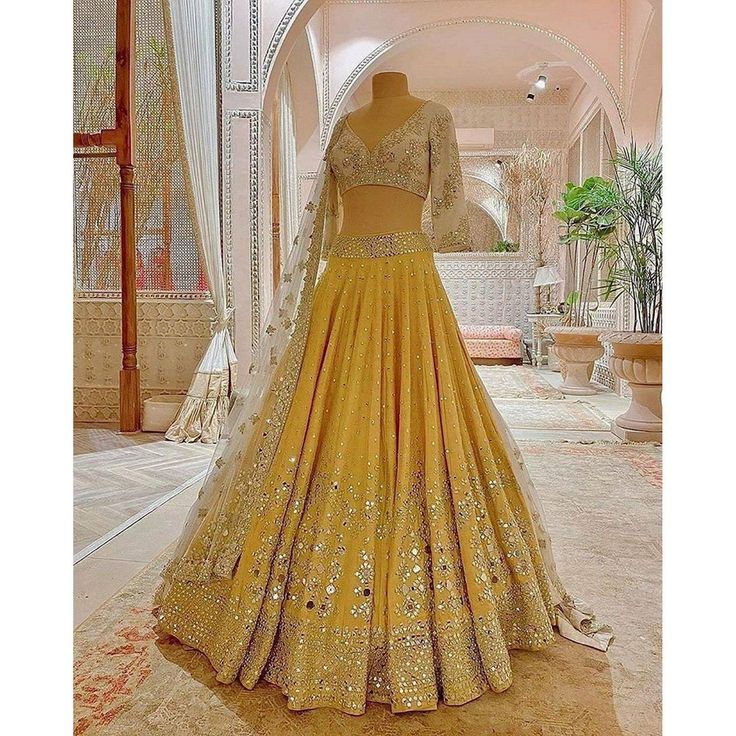
gagra choli
Ghagra choli (also known as lehenga choli and locally as chaniya choli) is a type of ethnic clothing for women from the Indian Subcontinent, notably in the Indian states of Rajasthan,[1][2] Gujarat,[3] Madhya Pradesh, Uttar Pradesh, Bihar, Haryana, Punjab, Himachal Pradesh, Uttarakhand, Jammu and Kashmir, as well as in the Pakistani provinces of Punjab and Sindh. In Punjab, the lehenga is traditionally worn with a kurti.[4][5] It is a combination of the gagra or lehenga (long skirt) and the choli (blouse), however in contemporary and modern usage lehenga choli is the more popular and widely accepted term by fashion designers, trend setters, and boutiques in South Asia, since ghagra is synonymous with the half-slip (petticoat) worn as an undergarment below the sari.
Thank you for reading this post, don't forget to subscribe!Terms and history[edit]

Historically, the gagra choli evolved from the three-piece attire worn by women in Indus Valley ancient India. The attire consisted of the antriya lower garment, the uttariya veil worn over shoulder or head and stanapatta a chest-band, which finds mentioned in Sanskrit literature and Buddhist Pali literature during the 6th century B.C.[6]
Choli[edit]

A choli (Hindi: चोली, Nepali: चोलो), (ravike in South India Telugu: రవికె, Kannada: ರವಿಕೆ) is a midriff-baring blouse commonly worn with a sari attire (worn in India, Pakistan, Sri Lanka, Bangladesh, Nepal and other surrounding countries). It evolved from the ancient Stanapatta (also known as Kanchuki) and is cut to fit tightly around the body with its short sleeves and low neck. The choli is usually cropped, allowing exposure of the navel; the cropped design is particularly well-suited to wear in the hot summers of the Indian subcontinent.
Lehenga, gagra/ghagra (Hindi: घाघरा ghāghrā) also chaniya[7] (known as pavadai in Tamil: பாவாடை) is a form of skirt which is long, embroidered and pleated. It is secured at the waist or hips and leaves the lower back and midriff bare.[8] The ancient version of skirt or ghagri evolved from bhairnivasani, which in turn evolved from the antriya when stitching on one side became tubular and was worn gathered together at the waist, and held by a girdle. This was one of the earliest forms of a clumsily stitched skirt. It was worn using a nada or drawstring. The ghagri was a narrow skirt 6 feet (1.8 m) long—the same length as the original antriya—and can still be seen worn by Jain nuns in India.
Until the early 20th century, women irrespective of class largely wore gagras which reached down to ankles, especially in the Hindi belt. This was largely due to jeweled toes indicating the marital status of women, as both married and unmarried women observed the ghoonghat veil. Gagras were made out of two to three layers of coarse khadi fabric which created large flared look and remained largely plain but were decorated with gota and badla embroidery on special occasions. Most commonly used dyes were indigo, lac and turmeric. This style can still be seen in rural areas of Haryana, Uttar Pradesh, Bihar & Madhya Pradesh particularly during folk festivals.
for more products, click on https://eraclassic.in/?product=t-shirt-3


 SPIN TO WIN!